 By Jay Phillips, Founder, PamliEcoConnect · October 24, 2026
The question we keep hearing
When we share the route map, one of the most common replies is some version of "That's nice, but what do you do when you get there?"
It's a fair question, and it might be the most important one anyone has asked us. Hatteras Island is about 50 miles of two-lane road. There is no bus line, and most of us can't picture life here without a truck. A passenger ferry that leaves your car on the mainland only helps if there's a way to get around once you step off the boat.
We don't think there's one answer. There are a lot of different people who might ride, and each needs something different on the other end. Here's how we're thinking about it so far. We'd like you to tell us where you think we're wrong.
People already do this every summer
If you've ridden the Ocracoke Express, you've already answered part of this question. Every summer, NCDOT's passenger ferry carries up to 129 people from Hatteras village straight into Silver Lake Harbor, with no cars aboard. In 2025, 18,786 people rode it, up 13% from the year before. (NCDOT)
Nobody seems troubled about getting around once they arrive. They walk, rent a bike or golf cart, or hop on Hyde County's free village tram, which meets the boat. The ferry handles the water, and the village handles the last mile.
To be fair, Ocracoke village is compact. Almost everything is within walking distance of the harbor. Hatteras Island is about 50 miles of villages strung along one road, so a single landing can't serve the whole island the way Silver Lake serves Ocracoke.
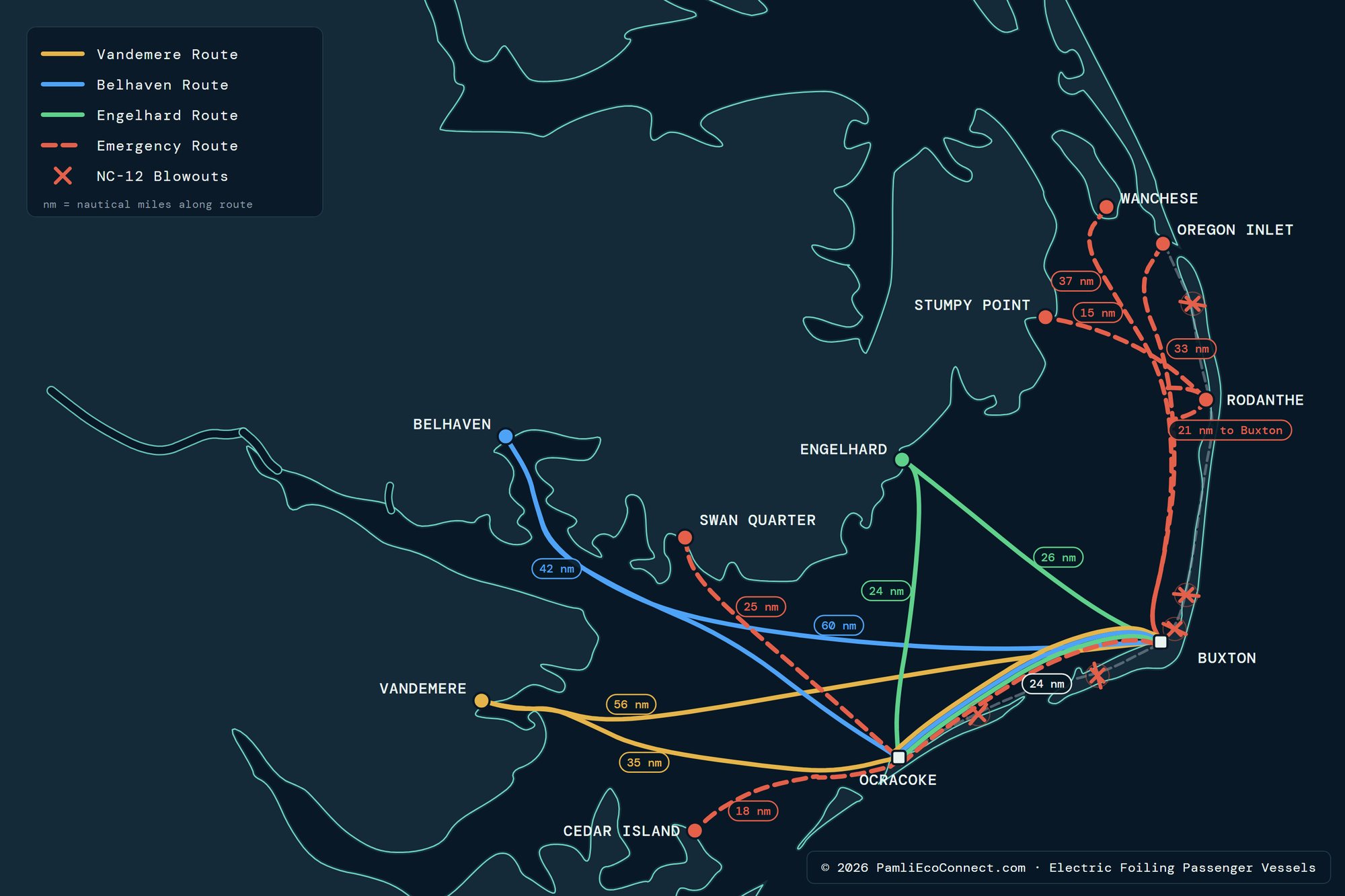
That's why we think in terms of several smaller landings rather than one big terminal: Buxton, Avon, Rodanthe, and other villages, each with its own way to get around. A smaller, lighter boat can reach docks a 129-passenger ferry can't, without needing a large terminal, a big crew, or a lot of fuel. Ocracoke shows the model works. What's left is to fit it to the way Hatteras is laid out.
How other passenger ferry networks handle the last mile
The Pamlico Sound isn't the only place working on this. Two passenger ferry systems to our north offer useful comparisons. Neither is the same situation as ours, but both have had to answer the same question.
The Chesapeake Bay Passenger Ferry Network (planned). Five Maryland counties formed a consortium to study passenger-only ferries across the Bay. Its 2024 feasibility study recommended starting with two 149-passenger and five 49-passenger catamarans, serving about 50,000 riders on six routes with fourteen stops. (Talbot Spy) Anne Arundel County then won a $3.9 million federal grant to start service between Annapolis, Baltimore, and Matapeake on Kent Island. (CBS Baltimore) Local critics are already asking our question. One reader there pointed out that a ferry works fine into Annapolis or Baltimore, but at smaller stops you're stuck unless someone has planned how you get around. (Talbot Spy) The Bay has also tried this before. The Chesapeake Flyer, a 105-passenger catamaran, started in 1990 and shut down in 1994 for lack of riders. In its first summer, the Washington Post reported the boat "still on sick list". A ferry that isn't running reliably doesn't build riders, which is one more reason we're starting with a test boat and thinking more in terms of a multi-vessel fleet of smaller 30 - 50 passenger vessels. (Bay Business Monthly)
There's a pattern in the attempts that struggled. A big boat comes with big costs: a large crew, heavy fuel bills, and docks, dredging and terminals built to match. It only pays when it runs full, so when ridership dips or the boat breaks down, the whole service is at risk. That model can work on a busy, deep-water route. On rural routes like the Pamlico Sound, with riders spread across many small towns and seasons, it's a hard way to make the numbers add up.
PamliEcoConnect is designed to be the opposite:
| Traditional fast ferry | PamliEcoConnect design | |
|---|---|---|
| Size | 100 to 250+ passengers | About 20 to 50 passengers |
| Power | Diesel, with heavy fuel bills | Battery-electric, using a fraction of the energy on foils |
| Crew | Several crew per trip | Small crew, sized to the boat, often just the Captain |
| Landings | Terminals and dredged channels | Existing village docks, about 2 feet of water |
| Break-even | Needs full boats | Smaller loads, more frequent trips, flex to demand |
Smaller boats can run more often, stop at more villages, and make money with fewer people aboard. If one is down for maintenance, the others keep running. The trade-off is that each boat carries fewer people, so it takes more trips to move a crowd, and every landing still needs a place to charge.
The Potomac water taxis (operating). A privately run water taxi network links The Wharf in DC with Georgetown, Old Town Alexandria, and National Harbor, with trips of about 30 to 45 minutes. (City Experiences) When the National Harbor–Alexandria link was approved, it was planned as privately financed and operated service with two 99-passenger boats. (Alexandria City Council docket) Alexandria paired it with a trolley so arriving visitors wouldn't need a car or taxi to get around Old Town. That is exactly the kind of last-mile plan we're talking about.
Electric hydrofoils on the Potomac. The Potomac is also where the next generation of fast passenger boats is showing what it can do. Candela, the Swedish hydrofoil builder, ran demonstration rides on the Potomac in October 2025 to make the case for its P-12 ferry. It pointed out that a water commute from Georgetown to Reagan National could take about six minutes, compared with roughly 20 by car. (Marine Log) New Zealand's Vessev followed with demonstrations of its VS-9 at the Washington Navy Yard, part of its push into the U.S. market. (Ship & Bunker) Vessev invited PamliEcoConnect to sea trial the VS-9 at the Navy Yard this fall, so we've seen this technology up close, not just on video. Both builders are betting that quiet, low-wake, electric hydrofoils can turn rivers and sounds into fast passenger routes. One difference matters for us: both boats are built overseas, and U.S. law requires domestic passenger ferries to be U.S.-built.
| Chesapeake (planned) | Potomac water taxis (running) | Pamlico Sound (PamliEcoConnect) | |
|---|---|---|---|
| Setting | Wide bay, cities and small towns | City and suburban waterfronts | Rural barrier islands and small mainland towns |
| Main purpose | Tourism and crossing the Bay | Tourism, events, short trips | Daily access, tourism, and a backup when NC-12 is cut |
| Getting around at the landing | Strong in cities, an open question at small stops | Walkable waterfronts, transit, trolleys, rideshare | Few options today, so it has to be built (see above) |
| Water | Deep enough for conventional catamarans | Deep river channel | Shallow, which favors small, light hydrofoils |
| Funding | County consortium and federal grants | Private operator | Public-private partnership |
The common lesson is that ferries succeed when the landing is somewhere people want to be, and when getting around after you arrive has been planned as carefully as the crossing. Where our situation differs is resilience. Neither Maryland nor DC is building a ferry because its only highway might wash out. And the hydrofoil technology now being shown on the Potomac is a better fit for the shallow, choppy Pamlico Sound than for a deep river channel.
Who might ride, and what each needs on arrival
Listed in the order we expect, from the most riders to the fewest:
| Rider | Why they'd ride | What they need when they land |
|---|---|---|
| Visitors from the Research Triangle and the mainland, and non-resident property owners | A much shorter trip to the coast. The state's study estimated 3.5 to 5 hours from the Triangle through Vandemere, versus 5.5 to 7 today | A rental car at the port, taxi, Uber, golf cart, or a rental house pickup. Owners may keep a car or cart on the island |
| Inner and Outer Banks residents | Medical appointments, shopping, family, airports. CarolinaEast in New Bern is the closest hospital for much of the Outer Banks | A car waiting at the mainland port, or a ride from a friend |
| Travelers during an NC-12 closure | Vacation renters who've already paid for the week, school and sports teams, anyone who has to get on or off the island | A ride to the house or the game, grocery delivery, a Dare County bus for teams. Being here without a car beats not getting here |
| Workers living on the Inner Banks | Lower-cost housing with about an hour's commute to island jobs | A dependable ride from the dock to the job site, often provided by the employer |
| Emergency services | Today, when NC-12 is closed, the options are a helicopter, a medical flight to Frisco, or an ambulance meeting a boat at the Oregon Inlet docks | A crew or ambulance waiting at the dock, which is how it already works |
The common thread is that the ferry handles the water and someone has to cover the last few miles. For some riders that's already in place, like the ambulance or the school bus. For others it's a service that doesn't exist yet, and we expect it will grow once there's a steady stream of people stepping off a boat.
Getting around once you land, at either end
On the island
The ferry would arrive at a dock, not a highway exit, so where those docks are matters. We'd like landings close to where people are actually going: villages, rental houses, campgrounds, and hotels. Docks near places like the Rodanthe campgrounds are the kind of stop we have in mind, but every landing has to be worked out with the property owner and the county first.
From the dock, people could get around in several ways:
- Rental cars waiting at the port (more on this below)
- Taxis, Uber, and local shuttles, which would have a steady new source of fares
- Golf carts and e-bikes for short trips within a village
- Rental house and hotel pickups, an easy extra for owners who want guests to come back
- Provisioning services that stock your rental before you arrive, so you aren't hauling groceries across the Sound
- A friend with a truck, which is how island life has always worked
On the mainland
This is the side people forget to ask about. An islander stepping off at Vandemere still has to get to New Bern, Greenville, or the airport, and rural Pamlico County has even less transit than Hatteras. A mainland port with no ride waiting is just a dock. The good news is that when state researchers visited Vandemere, local residents and medical providers said they'd be willing to give rides to people arriving by ferry, including trips to the airports in Raleigh and New Bern (see below).
Rental cars at every port
We're in conversations with rental car companies about having cars ready at each of our ports, on both the island and the mainland. The goal is simple. You book your ferry seat and your car together, and the car is at the dock when you step off. Nothing is signed yet, and we'll share details when there's something real to share.
One question for you: would you use it? (It’s in the survey at the end.) Knowing that helps us make the case to the companies we're talking with.
The bigger trade: jobs on the island, homes on the mainland
Every business on Hatteras knows the problem: there aren't enough workers, because there isn't enough housing they can afford. Meanwhile, the Inner Banks has housing at a fraction of beach prices and people looking for steady work, many of whom already drive a long distance to work on the Outer Banks.
A commute of about an hour across the Sound could connect the two. That only works if the ride on each end is dependable, which ties back to everything above. An employer van at the dock, or a shared ride from the mainland port, turns a long-shot idea into a daily routine.
We're not claiming this solves the housing problem. We think it gives people another option, and people are good at making options work. The benefits don't have to suit everyone. They only have to be worth the trade-offs for the people who choose to ride.
Visitors without cars spend their money in the village
There's an upside to arriving without a car that's easy to miss. A visitor who drives in can spend the week making runs to the big stores up the beach. A visitor who walks off a ferry spends their money close to where they're staying: the corner store, the local restaurant, the bike rental, the fishing charter, the outfitter who drops off kayaks.
That works in favor of small villages and the businesses that keep them going. Fewer cars on NC-12 also means more parking left for the people who live here.
What the state's own study found
We're not the first to look at this. In March 2023, NC State's Institute for Transportation Research and Education (ITRE) finished a passenger ferry feasibility study for NCDOT. Researchers visited Vandemere on October 17, 2022, and looked at four possible terminal sites. (Passenger Ferry Feasibility Study – Other Routes, RP 2021-19)
To be clear about what it is: the study looked at service from Vandemere to Ocracoke. It did not evaluate PamliEcoConnect, our vessels, or a Hatteras landing. But many of its findings speak directly to the question in this article.
| What the study looked at | What it found |
|---|---|
| Travel time, Triangle to Ocracoke | 5.5 to 7 hours today, versus an estimated 3.5 to 5 hours through Vandemere (about 2.5 hours of driving plus a little over an hour on the ferry) |
| Market | About 1.85 million people in the Raleigh, Durham, and Chapel Hill area at the time. Now 2.1 million |
| What 1% of that market would mean | 18,500 additional trips, about $3.2 million in direct visitor spending, 50+ jobs, and $5.5 million in yearly economic output |
| Getting around at Vandemere | Medical providers and local residents said they'd be willing to give rides to arriving passengers, including runs to RDU and the New Bern airport |
| Parking at Vandemere | The lead site, next to Waterfront Park, has 8–10 ft of water and room for 50–100 cars. Golf carts or shuttles were discussed for the other sites |
| Islanders on the mainland | Access to Pamlico County doctors, dentists, pharmacies, schools, daycare, and elder care. CarolinaEast in New Bern is the closest hospital |
| Workers | People living near Vandemere could commute to island jobs during the busy season |
| Storms | The route would give residents and visitors another way off the island |
| Local business | Developers have already talked with the town about bed-and-breakfasts, hotels, restaurants, and wedding venues to serve ferry traffic |
The study also measured the state's own passenger ferry, the Ocracoke Express. It found the ferry supports 55 jobs and $4.2 million in business output, which shows that small passenger boats can pay off for the communities they serve.
An earlier state study of the Hatteras–Ocracoke passenger ferry reached a conclusion that matters here. It said terminals, parking, and ways to get around on foot had to be in place before service started. In other words, the landing matters as much as the boat. We agree, and it's why we're working on rides at both ends now instead of after the boats are running.
Why not just bring the car?
We get this one a lot, and we'd like to be able to say yes. The problem is the water.
Pamlico Sound is wide and shallow, and a lot of it is only a few feet deep. Fast ferries that carry cars do exist. The Lake Express on Lake Michigan is one example, and it moves at about 34 knots. But it's 192 feet long and draws 8 feet 2 inches of water. (Lake Express) Most of the Pamlico Sound is only 5 to 6 feet deep, with wide shallow flats and shoals that make it hazardous for larger vessels. (Pamlico Sound) A boat like that would be aground before it left the channel.
A small, light passenger hydrofoil can. When it's up on its foils, the hull lifts clear of the water, and it can reach landings that a big car ferry never could. The trade is that your car stays home, or waits for you at the port.
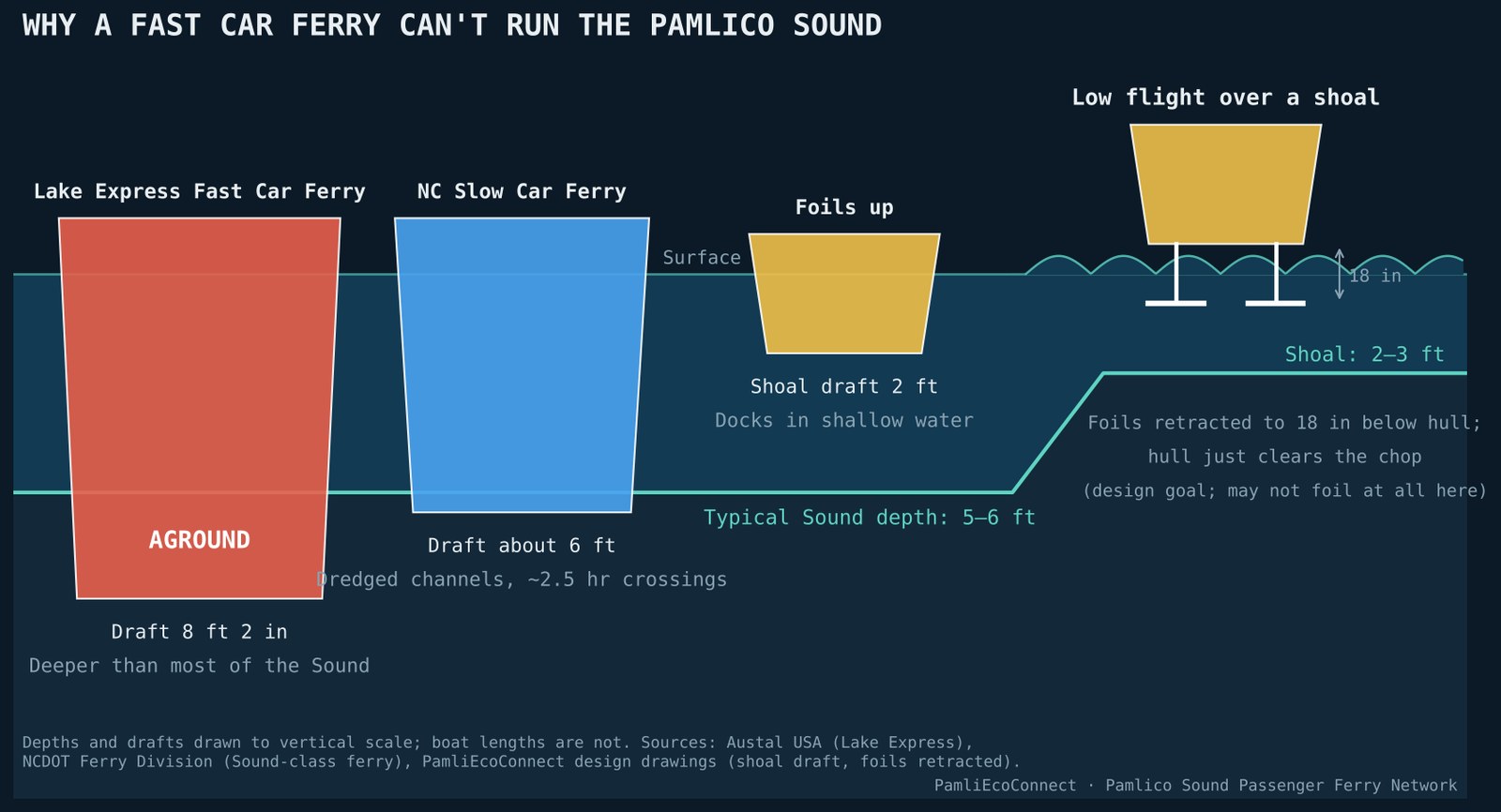
That's why carrying cars across the Sound will always be slow. The state's own car ferries already draw about 6 feet, need constantly dredged channels, and take about 2½ hours to cross from Swan Quarter or Cedar Island to Ocracoke. When NC-12 is out, those slow boats are the only way to move a vehicle. A fast boat across the Sound has to be small, light, and carry people, not cars.
When NC-12 closes, how many people can still cross?
This week gave us a real-world test. NC-12 closed at Pea Island on October 20, and NCDOT started 24-hour emergency ferry service between Stumpy Point and Rodanthe with three boats, about two hours each way. (NCDOT) From Thursday morning through Saturday morning it carried about 1,200 passengers and 755 vehicles, with hours-long waits at both terminals. (Island Free Press)
Here's how that compares with a normal day on NC-12, and with what four small passenger boats could add:
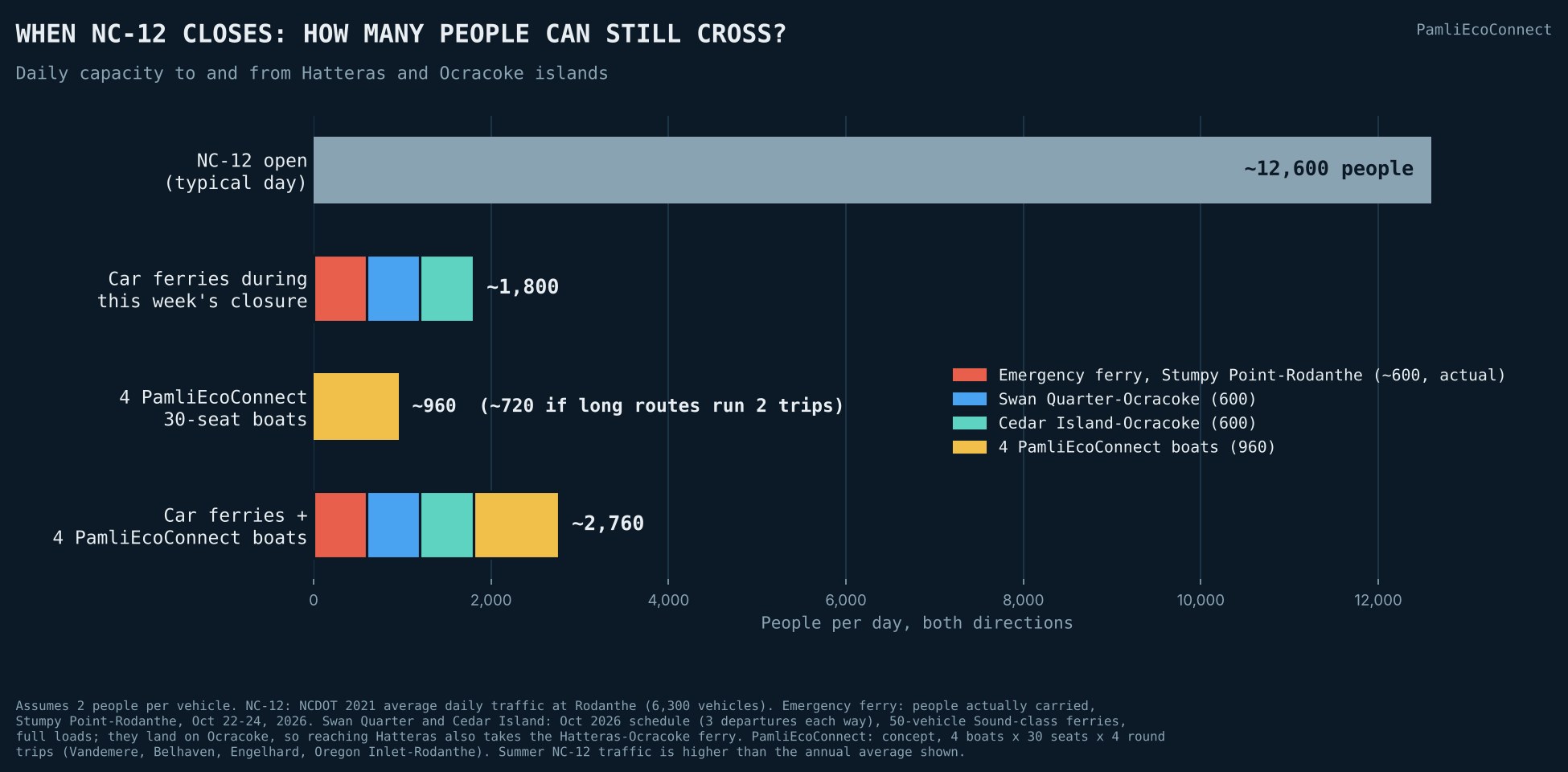
| Link | Vehicles per day | People per day | Basis |
|---|---|---|---|
| NC-12 open, at Rodanthe | ~6,300 | ~12,600 | NCDOT 2021 average daily traffic |
| Emergency ferry, Stumpy Point–Rodanthe | ~375 | ~600 | Actually carried, Oct 22–24, 2026 |
| Swan Quarter–Ocracoke | up to 300 | up to 600 | 3 departures each way, 50-vehicle ferries, full |
| Cedar Island–Ocracoke | up to 300 | up to 600 | 3 departures each way, 50-vehicle ferries, full |
| 4 PamliEcoConnect boats (concept) | 0 | ~720–960 | 30 seats, 2–4 round trips per route |
Three things stand out. First, nothing on the water comes close to replacing the road: with NC-12 closed, the whole car ferry network moves about a seventh of a normal day's traffic. Second, the Swan Quarter and Cedar Island ferries land on Ocracoke, so getting to Hatteras that way also takes the Hatteras–Ocracoke ferry. Third, four small passenger boats could add roughly 40 to 50 percent to the number of people the system can move, and they'd carry more people per day than the emergency ferry carried this week.
That's the role we see for PamliEcoConnect: not a replacement for NC-12 or the state ferries, but more capacity for people, on more routes, when the road is cut and the lines are long.
How we figured it: 2 people per vehicle. NC-12 count is NCDOT's 2021 annual average at Rodanthe; summer days run higher. Ferry figures use the October 2026 schedules. PamliEcoConnect numbers assume four 30-seat boats on the Vandemere, Belhaven, Engelhard, and Oregon Inlet–Rodanthe routes, with the two long routes running 2 round trips a day and the two short routes running 4.
Why the Pamlico Sound needs a different kind of hydrofoil
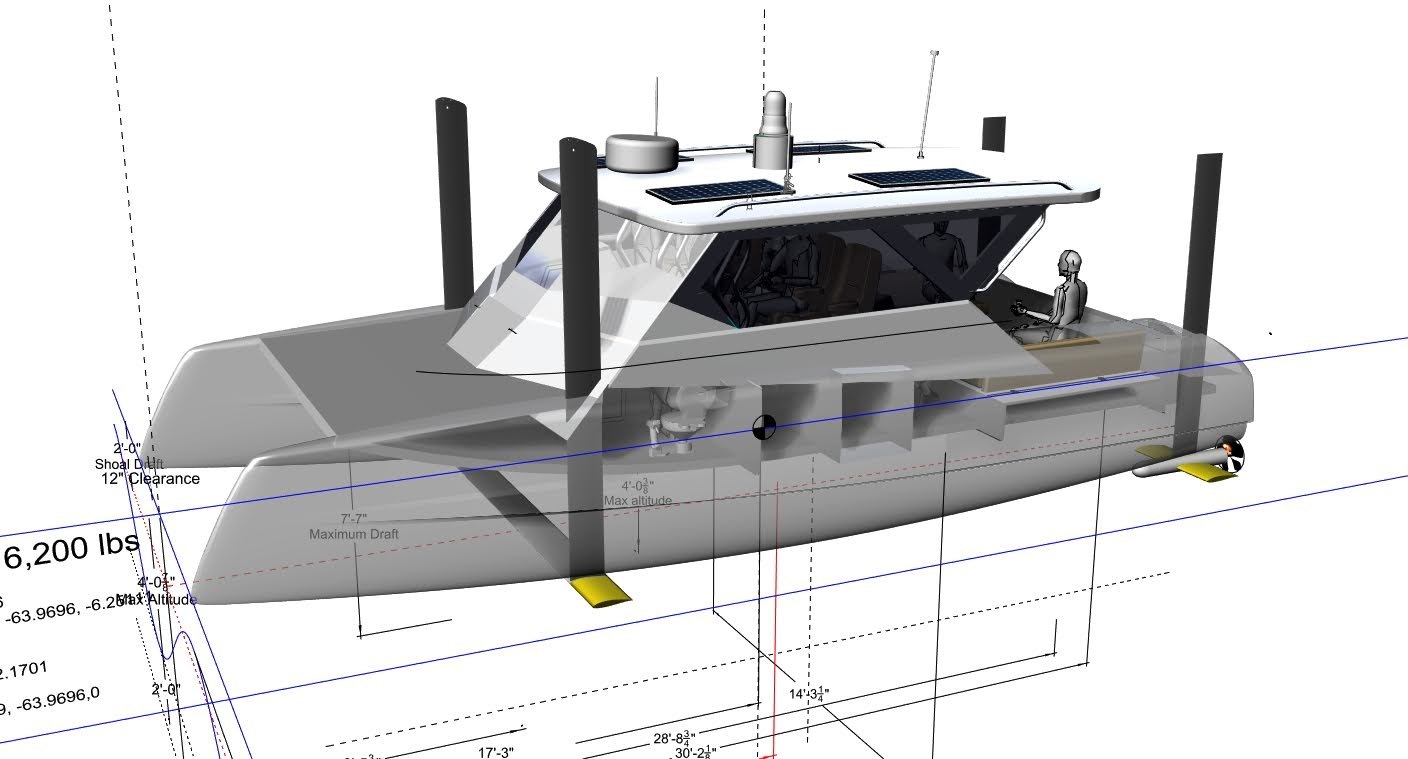
The foiling boats running today are impressive, and they've proven the technology. But the Pamlico Sound asks more of a boat than a city river or a sheltered harbor does. It's mostly 5 to 6 feet deep and full of shoals, our routes across it run 24 to 60 nautical miles, and it's exposed to Hatteras weather, so the chop can build fast and steep.
Here's how the leading boats compare to what the Sound demands:
| Candela P-12 | Vessev VS-9 | Artemis EF-24 | What the Pamlico Sound needs | |
|---|---|---|---|---|
| Range | About 40 nm at 25 kt | 40–50 nm | About 70 nm | Enough for the longest network legs (up to about 60 nm, Belhaven–Buxton) with a weather reserve |
| Shallow water | Foils retract for shallow water, as a mode selected off foil | Foils retract; about 1'8" draft with foils up | About 3 m (10 ft) draft | Shallow draft and the ability to keep flying over shoals under 4 ft. |
| Rough water | Built for coastal commuting | Rated to foil in waves up to about 2'6" | Built for open water, deep draft | More clearance for the steep chop a Hatteras blow builds |
Sources: Candela, Vessev specifications, Fast Company, Electric & Hybrid Marine Technology
Each of these boats does some of what the Sound needs. None of them does all of it. Our design goal is to combine all four in one U.S.-built boat:
- Shallow-water capability for a sound full of shoals
- Foils that can retract while the boat is flying, so it can respond to shoaling water without coming off foil
- Extra wave-height clearance for Hatteras weather
- Longer range, to run the full network with a safe reserve
That's the next step for foiling boats, and it's what the test boat is for. These are design goals, not yet proven on the water. That's why step one is a working test boat on the Pamlico Sound, gathering real data before we lock in a design.
Tell us what we're missing
People who have lived on this island for generations know things about getting around here that we never will. So here are our questions for you:
- If NC-12 were closed and you could get to the island without your car, would you go? What would you need when you landed?
- Where would a dock actually be useful, on the island or on the mainland?
- Would you use a rental car that was waiting at the port?
- If you run a taxi, shuttle, rental, or provisioning business, would steady ferry traffic be worth planning around?
The quickest way to tell us is the short survey below. You can also leave a comment, send us a message, or call Jay at 252-489-8193. Read the rest of our FAQs at pamliecoconnect.com.
Founder, PamliEcoConnect · 252-489-8193